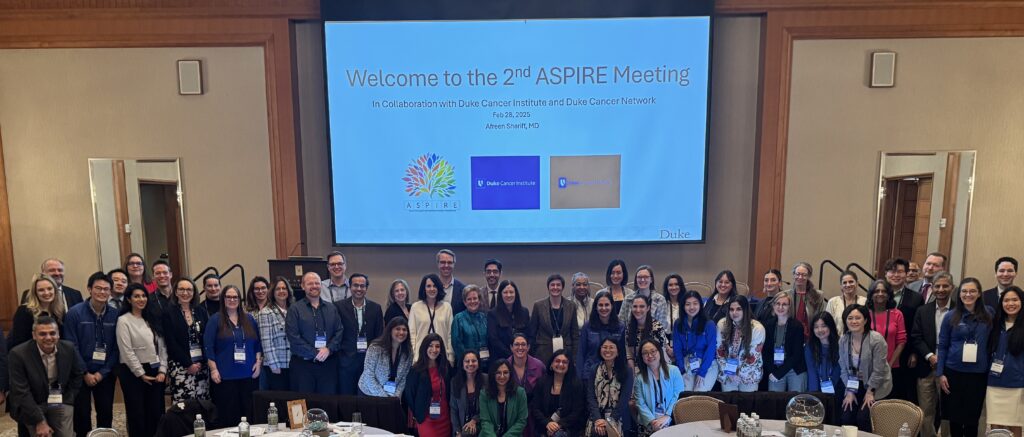
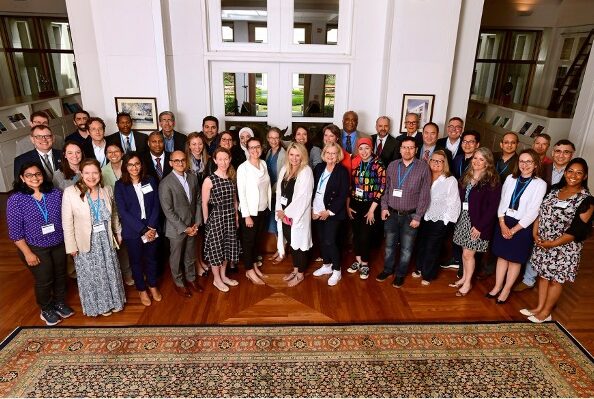
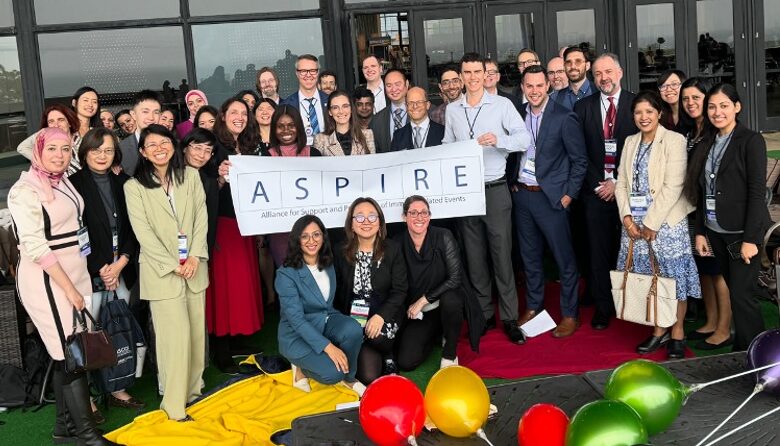
The Alliance for Support and Prevention of Immune-Related Adverse Events (ASPIRE) is a consortium uniting top cancer centers to advance real-world data, clinical trials, and cross-specialty solutions.
Our mission is to unite the health care team and people with cancer alongside industry and regulatory stakeholders in a collaborative effort for innovative research to advance the prevention, diagnosis, and management of immune-related adverse events (irAEs) associated with immunotherapies; to ensure that people with cancer achieve the highest standard of care and quality of life through evidence-based research.
ASPIRE Community of Practice (CoP) was launched within the American Society of Clinical Oncology (ASCO) as a space for collaboration, discussion, and shared learning, with a focus on enhancing the prevention, diagnosis, and management of immune-related adverse events (irAEs) associated with immunomodulating cancer therapies.
This pilot CoP is open to all ASCO oncology members — and to ALL non-oncology subspecialists who partner with us to care for patients receiving cancer immunotherapy. For a limited time, membership is free for non-oncology subspecialists.
“When clinicians, researchers, patients, advocates, and institutions come together, such as the case with ASPIRE, we can accelerate progress in ways that no single person or a group (such as our Severe Immunotherapy Complications service) could accomplish alone. We are building common language, creating true standards of care, advancing research, educating the next generation, and most importantly ensuring that patients facing these complications feel seen, heard, and cared for.
To me, ASPIRE represents the VERY best of medicine — collaboration, community, and a shared commitment to improving the lives of our amazing patients navigating some of the most complex moments in cancer care.” — Kerry Reynolds, MD, Director of the Severe Immunotherapy Complications Service at Mass General Cancer Center and ASPirE Co-Founder
Meet Our Executive Committee
Pauline Funchain, MD
Co-Founder
Dr. Pauline Funchain is a medical oncologist and Associate Professor at Stanford Medicine, specializing in Melanoma and Cutaneous malignancies. She also serves as the Associate Director for Cancer Research Training and Education, Associate Program Director of the Hematology and Oncology Fellowship, Co-Director of the Immunotherapy Toxicity Program and Co-Director of the Skin Cancer Genomics Program at Stanford Medicine.
Alexa Meara, MD
co-founder
Dr. Alexa Meara is a rheumatologist and the Director of the Immunotherapy Management Clinic (IMC) at The Ohio State University Cancer Center. Her clinical and research time is dedicated to defining how cancer treatments disrupt the immune system and create brand-new autoimmune diseases. She is leading research in how to define and classify these new autoimmune sequelae and developing evidence-based steroid-sparing guidelines. She is the
Kerry Reynolds, MD
Co-Founder
Dr. Kerry Reynolds is a board-certified oncologist at the Massachusetts General Hospital Cancer Center and an Assistant Professor of Medicine at Harvard Medical School. She is the Director of the Severe Immunotherapy Complications Service and the Clinical Director for inpatient cancer services at Mass General Cancer Center.
Noha Abdelwahab Hassan, MD, PhD
Executive Committee
Dr. Noha Abdelwahab Hassan is an Assistant Professor in the Department of Rheumatology and Clinical Immunology, Division of Internal Medicine at The University of Texas MD Anderson Cancer Center. She also serves a joint appointment as Assistant Professor in the Division of Department of Melanoma Medical Oncology, MD Anderson Cancer Center and Associate Professor with tenure and Consultant of Rheumatology in the Departments of Rheumatology, Rehabilitation and Physical Medicine, Assiut University Faculty of Medicine, Assiut University Hospitals, Assiut.
Matthew Hadfield, DO
Executive Committee
Dr. Matthew Hadfield is an Assistant Professor of Medicine at the Brown University Alpert School of Medicine. He completed an internal medicine residency at the University of Connecticut and completed a Hematology/Oncology Fellowship at Brown University. He has a strong research interest in immunotherapy-related toxicities.
Kriti Mittal, MD, MS
Executive Committee
Dr. Kriti Mittal is an assistant professor of medicine at UMass and a physician in the Division of Hematology/Oncology who specializes in genitourinary cancers. Dr. Mittal’s research focuses on minimizing treatment-related toxicities. As co-chair of the cancer committee at UMass Memorial, Dr. Mittal helps guide the cancer center’s growth. A clinical investigator, Dr. Mittal works to bring new trials to patients locally.
Aliyah Pabani, MD, MPH
Executive Committee
Dr. Aliyah Pabani is an Assistant Professor of Oncology at the Sidney Kimmel Comprehensive Cancer at Johns Hopkins in the Upper Aerodigestive Cancer Division (UAD). She is Co-Director of the Immune-Related (IR) Toxicity Team. Dr. Pabani conducts clinical and translational research in immunotherapy-related adverse events and immunotherapy in squamous cell cancers.
Eric Roeland, MD, FASCO, FAAHPM
Executive Committee
Dr. Eric Roeland is an Associate Professor at the Oregon Health and Science University and the Director of the Knight Cancer Institute’s Symptom Science Research Program. He is a medical oncologist and palliative care specialist whose research focuses on interventions to improve poorly controlled symptoms for people living with cancer. He also serves as the Chair of the ASCO Evidence-Based Medicine Committee.
Bryan J. Schneider, MD
Executive Committee
Dr. Bryan J. Schneider is a Professor of Internal Medicine in the Division of Hematology/ Oncology at the University of Michigan, Ann Arbor, Michigan, and is the section head for the medical thoracic oncology team who treats lung cancer, esophageal cancer, mesothelioma, thymoma and carcinoid tumors. Dr. Schneider’s research focuses on developing new strategies for treating Lung and Esophageal cancer. He conducts clinical trials through the University of Michigan Rogel Cancer Center’s Phase I Program.
Afreen Idris Shariff, MD
Executive Committee
Dr. Afreen Idris Shariff is an Associate Professor of Medicine, Endocrinology, Metabolism, and Nutrition at Duke. She developed the Duke Endo-Oncology Program which provides care to cancer patients who develop diabetes, thyroid, adrenal, and other side effects from cancer treatments like chemotherapy, radiation therapy, and immunotherapy.
Elad Sharon, MD, MPH
Executive Committee
Dr. Elad Sharon is a medical oncologist at the Dana-Farber Cancer Institute, where he is the Clinical and Translational Director of the Immunotherapy Toxicity Program and a member of the Faculty of Medicine at Harvard Medical School. From 2011 through August 2023, Dr. Sharon served as a senior investigator in the Investigational Drug Branch of the NCI Cancer Therapy Evaluation Program (CTEP). In that role, he worked with academic and industry colleagues to develop promising new cancer therapies. His portfolio included antibody-drug conjugates, immune checkpoint inhibitors and other agents.
Yinghong Wang, MD
Executive Committee
Dr. Yinghong (Mimi) Wang is a professor on tenure track in the Department of Gastroenterology, Hepatology & Nutrition at MD Anderson. Dr. Wang’s expertise lies in areas including inflammatory bowel disease (IBD), fecal microbiota transplantation (FMT), and cancer immunotherapy-induced gastrointestinal toxicities. At MD Anderson, she has garnered recognition for her adept management of cancer immunotherapy-induced GI toxicities, establishing an IBD clinic and FMT.